特别需要指出的是,本教程后续的快速傅里叶变换代码只支持 2 的幂次大小的输入,而优质的库可以对任意大小执行 FFT。
以下是几个优质的免费库(请仔细查看其许可证,以确认是否可用于您的项目):







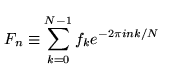
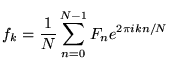
// working with fixed sizes for simplicity in this tutorial
const int N = 128;

double fRe[N]; //the function's real part, imaginary part, and amplitude
double fIm[N];
double fAmp[N];
double FRe[N]; //the FT's real part, imaginary part and amplitude
double FIm[N];
double FAmp[N];
const double pi = 3.1415926535897932384626433832795;

void DFT(int n, bool inverse, const double *gRe, const double *gIm, double *GRe, double *GIm); //Calculates the DFT
void plot(int yPos, const double *g, double scale, bool trans, ColorRGB color); //plots a function
void calculateAmp(int n, double *ga, const double *gRe, const double *gIm); //calculates the amplitude of a complex function
|
int main(int /*argc*/, char */*argv*/[])
{
  screen(640, 480, 0, "1D DFT");
  cls(RGB_White);

  for(int x = 0; x < N; x++)
  {
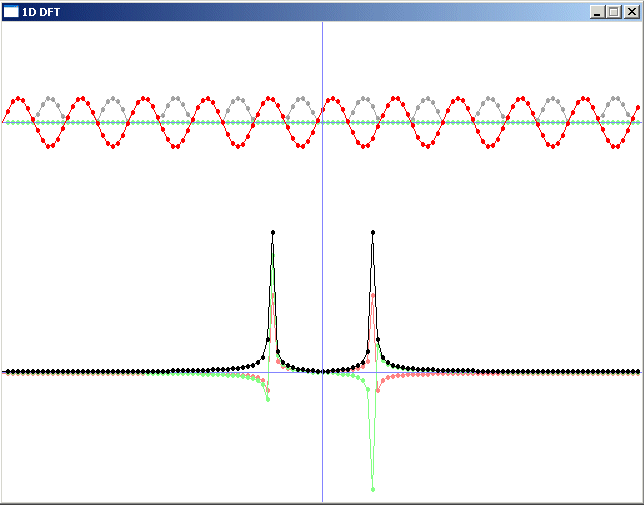
    fRe[x] = 25 * sin(x / 2.0); //generate a sine signal.  Put anything else you like here.
    fIm[x] = 0;
  }

  //Plot the signal
  calculateAmp(N, fAmp, fRe, fIm);
  plot(100, fAmp, 1.0, 0, ColorRGB(160, 160, 160));
  plot(100, fIm, 1.0, 0, ColorRGB(128, 255, 128));
  plot(100, fRe, 1.0, 0, ColorRGB(255, 0, 0));

  DFT(N, 0, fRe, fIm, FRe, FIm);

  //Plot the FT of the signal
  calculateAmp(N, FAmp, FRe, FIm);
  plot(350, FRe, 12.0, 1, ColorRGB(255, 128, 128));
  plot(350, FIm, 12.0, 1, ColorRGB(128, 255, 128));
  plot(350, FAmp, 12.0, 1, ColorRGB(0, 0, 0));

  drawLine(w / 2, 0, w / 2, h - 1, ColorRGB(128, 128, 255));
  redraw();
  sleep();

  return 0;
}
|
void DFT(int n, bool inverse, const double *gRe, const double *gIm, double *GRe, double *GIm)
{
  for(int w = 0; w < n; w++)
  {
    GRe[w] = GIm[w] = 0;
    for(int x = 0; x < n; x++)
    {
      double a = -2 * pi * w * x / float(n);
      if(inverse) a = -a;
      double ca = cos(a);
      double sa = sin(a);
      GRe[w] += gRe[x] * ca - gIm[x] * sa;
      GIm[w] += gRe[x] * sa + gIm[x] * ca;
    }
    if(!inverse)
    {
      GRe[w] /= n;
      GIm[w] /= n;
    }
  }
}
|
void plot(int yPos, const double *g, double scale, bool shift, ColorRGB color)
{
  drawLine(0, yPos, w - 1, yPos, ColorRGB(128, 128, 255));
  for(int x = 1; x < N; x++)
  {
    int x1, x2, y1, y2;
    int x3, x4, y3, y4;
    x1 = (x - 1) * 5;
    //Get first endpoint, use the one half a period away if shift is used
    if(!shift) y1 = -int(scale * g[x - 1]) + yPos;
    else y1 = -int(scale * g[(x - 1 + N / 2) % N]) + yPos;
    x2 = x * 5;
    //Get next endpoint, use the one half a period away if shift is used
    if(!shift) y2 = -int(scale * g[x]) + yPos;
    else y2 = -int(scale * g[(x + N / 2) % N]) + yPos;
    //Clip the line to the screen so we won't be drawing outside the screen
    clipLine(x1, y1, x2, y2, x3, y3, x4, y4);
    drawLine(x3, y3, x4, y4, color);
    //Draw circles to show that our function is made out of discrete points
    drawDisk(x4, y4, 2, color);
  }
}
|
//Calculates the amplitude of *gRe and *gIm and puts the result in *gAmp
void calculateAmp(int n, double *gAmp, const double *gRe, const double *gIm)
{
  for(int x = 0; x < n; x++)
  {
    gAmp[x] = sqrt(gRe[x] * gRe[x] + gIm[x] * gIm[x]);
  }
}
|
还存在其他算法,可以快速处理非 2 的幂大小的信号,甚至是大质数。例如混合基 Cooley-Tukey 算法以及其他算法。但这超出了本教程的范围。上面库部分链接的代码支持非 2 的幂,因此对于实际应用我建议使用类似的库。但在本教程中,我们继续使用更简单的代码进行演示。
以下是 DFT 函数的新版本,称为 FFT,使用上述 radix-2 算法。您可以将其添加到之前的程序中,并将函数调用改为 FFT 来测试它。
首先,该函数将计算 n 的对数,这是算法所需要的。
void FFT(int n, bool inverse, const double *gRe, const double *gIm, double *GRe, double *GIm)
{
  //Calculate m=log_2(n)
  int m = 0;
  int p = 1;
  while(p < n)
  {
    p *= 2;
    m++;
  }
|
  //Bit reversal
  GRe[n - 1] = gRe[n - 1];
  GIm[n - 1] = gIm[n - 1];
  int j = 0;
  for(int i = 0; i < n - 1; i++)
  {
    GRe[i] = gRe[j];
    GIm[i] = gIm[j];
    int k = n / 2;
    while(k <= j)
    {
      j -= k;
      k /= 2;
    }
    j += k;
  }
|
  //Calculate the FFT
  double ca = -1.0;
  double sa = 0.0;
  int l1 = 1, l2 = 1;
  for(int l = 0; l < m; l++)
  {
    l1 = l2;
    l2 *= 2;
    double u1 = 1.0;
    double u2 = 0.0;
    for(int j = 0; j < l1; j++)
    {
      for(int i = j; i < n; i += l2)
      {
        int i1 = i + l1;
        double t1 = u1 * GRe[i1] - u2 * GIm[i1];
        double t2 = u1 * GIm[i1] + u2 * GRe[i1];
        GRe[i1] = GRe[i] - t1;
        GIm[i1] = GIm[i] - t2;
        GRe[i] += t1;
        GIm[i] += t2;
      }
      double z =  u1 * ca - u2 * sa;
      u2 = u1 * sa + u2 * ca;
      u1 = z;
    }
    sa = sqrt((1.0 - ca) / 2.0);
    if(!inverse) sa =- sa;
    ca = sqrt((1.0 + ca) / 2.0);
  }
|
  //Divide through n if it isn't the IDFT
  if(!inverse)
  for(int i = 0; i < n; i++)
  {
    GRe[i] /= n;
    GIm[i] /= n;
  }
}
|
const int N = 128; //yeah ok, we use old fashioned fixed size arrays here

double fRe[N]; //the function's real part, imaginary part, and amplitude
double fIm[N];
double fAmp[N];
double FRe[N]; //the FT's real part, imaginary part and amplitude
double FIm[N];
double FAmp[N];
const double pi = 3.1415926535897932384626433832795;

void FFT(int n, bool inverse, const double *gRe, const double *gIm, double *GRe, double *GIm); //Calculates the DFT
void plot(int yPos, const double *g, double scale, bool trans, ColorRGB color); //plots a function
void calculateAmp(int n, double *ga, const double *gRe, const double *gIm); //calculates the amplitude of a complex function
|
int main(int /*argc*/, char */*argv*/[])
{
  screen(640, 480, 0, "Fourier Transform and Filters");
  for(int x = 0; x < N; x++) fRe[x] = fIm[x] = 0;
  bool endloop = 0, changed = 1;
  int n = N;
  double p1 = 25.0, p2 = 2.0;
  while(!endloop)
  {
    if(done()) end();
    readKeys();
|
    if(keyPressed(SDLK_z)) {for(int x = 0; x < n; x++) fRe[x] = 0; changed = 1;} //zero
    if(keyPressed(SDLK_a)) {for(int x = 0; x < n; x++) fRe[x] = p1; changed = 1;} //constant
    if(keyPressed(SDLK_b)) {for(int x = 0; x < n; x++) fRe[x] = p1 * sin(x / p2); changed = 1;} //sine


    //ETCETERA... *snip*

    if(keyPressed(SDLK_SPACE)) endloop = 1;
|
    if(changed)
    {
      cls(RGB_White);
      calculateAmp(N, fAmp, fRe, fIm);
      plot(100, fAmp, 1.0, 0, ColorRGB(160, 160, 160));
      plot(100, fIm, 1.0, 0, ColorRGB(128, 255, 128));
      plot(100, fRe, 1.0, 0, ColorRGB(255, 0, 0));

      FFT(N, 0, fRe, fIm, FRe, FIm);
      calculateAmp(N, FAmp, FRe, FIm);
      plot(350, FRe, 12.0, 1, ColorRGB(255, 128, 128));
      plot(350, FIm, 12.0, 1, ColorRGB(128, 255, 128));
      plot(350, FAmp, 12.0, 1, ColorRGB(0, 0, 0));

      drawLine(w / 2, 0, w / 2, h - 1, ColorRGB(128, 128, 255));
      print("Press a-z to choose a function, press the arrows to change the imaginary part, press space to accept.", 0, 0, RGB_Black);
      redraw();
    }
    changed = 0;
  }
|
  //The original FRe2, FIm2 and FAmp2 will become multiplied by the filter
  double FRe2[N];
  double FIm2[N];
  double FAmp2[N];
  for(int x = 0; x < N; x++)
  {
    FRe2[x] = FRe[x];
    FIm2[x] = FIm[x];
  }
  cls();
  changed = 1; endloop = 0;
  while(!endloop)
  {
    if(done()) end();
    readKeys();
|
    if(keyPressed(SDLK_z))
    {
      for(int x = 0; x < n; x++)
      {
        FRe2[x] = FRe[x];
        FIm2[x] = FIm[x];
      }
      changed = 1;
    } //no filter
    if(keyPressed(SDLK_a))
    {
      for(int x = 0; x < n; x++)
      {
        if(x < 44 || x > N - 44)
        {
          FRe2[x] = FRe[x];
          FIm2[x] = FIm[x];
        }
        else FRe2[x] = FIm2[x] = 0;
      }
      changed = 1;
    } //LP

    //ETCETERA... *snip*
|
    if(changed)
    {
      cls(RGB_White);
      FFT(N, 1, FRe2, FIm2, fRe, fIm);
      calculateAmp(N, fAmp, fRe, fIm);
      plot(100, fAmp, 1.0, 0, ColorRGB(160, 160, 160));
      plot(100, fIm, 1.0, 0, ColorRGB(128, 255, 128));
      plot(100, fRe, 1.0, 0, ColorRGB(255, 0, 0));

      calculateAmp(N, FAmp2, FRe2, FIm2);

      plot(350, FRe2, 12.0, 1, ColorRGB(255, 128, 128));
      plot(350, FIm2, 12.0, 1, ColorRGB(128, 255, 128));
      plot(350, FAmp2, 12.0, 1, ColorRGB(0, 0, 0));

      drawLine(w/2, 0,w/2,h-1, ColorRGB(128, 128, 255));
      print("Press a-z to choose a filter. Press esc to quit.", 0, 0, RGB_Black);
      redraw();
    }
    changed=0;
  }

  return 0;
}
|
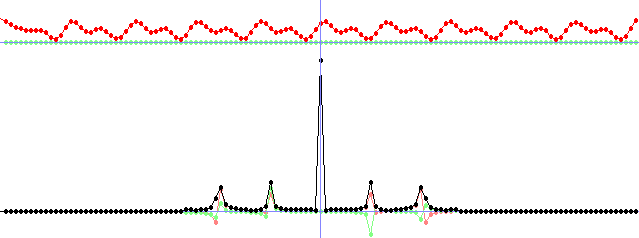
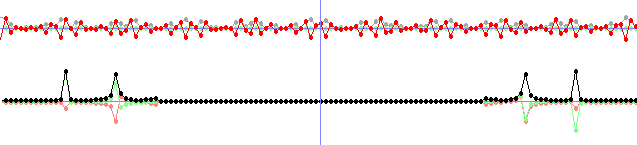
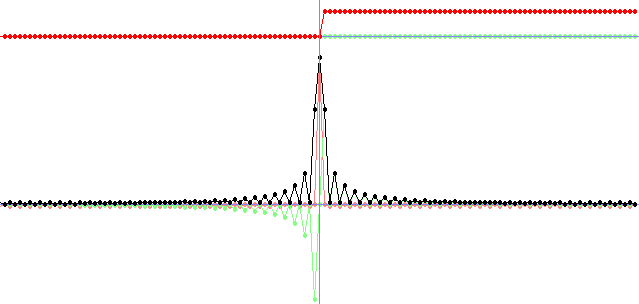
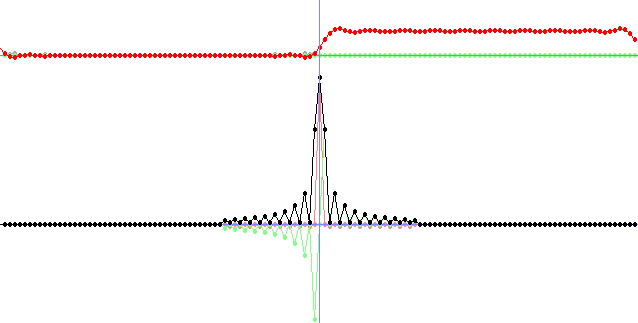

/// working with fixed sizes for simplicity in this tutorial
const int W = 128; //the width of the image
const int H = 128; //the height of the image

double fRe[H][W][3], fIm[H][W][3], fAmp[H][W][3]; //the signal's real part, imaginary part, and amplitude
double FRe[H][W][3], FIm[H][W][3], FAmp[H][W][3]; //the FT's real part, imaginary part and amplitude
double fRe2[H][W][3], fIm2[H][W][3], fAmp2[H][W][3]; //will become the signal again after IDFT of the spectrum
double FRe2[H][W][3], FIm2[H][W][3], FAmp2[H][W][3]; //filtered spectrum

double pi = 3.1415926535897932384626433832795;

void draw(int xpos, int yPos, int w, int h, const double *g, bool shift, bool neg128);
void DFT2D(int w, int h, bool inverse, const double *gRe, const double *gIm, double *GRe, double *GIm);
void FFT2D(int w, int h, bool inverse, const double *gRe, const double *gIm, double *GRe, double *GIm);
void calculateAmp(int w, int h, double *ga, const double *gRe, const double *gIm);
|
int main(int /*argc*/, char */*argv*/[])
{
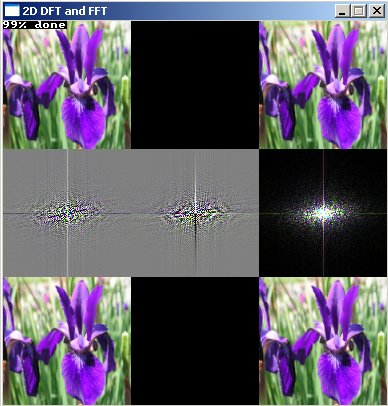
  screen(N * 3, M * 3, 0, "2D DFT and FFT");

  std::vector<ColorRGB> img;
  unsigned long dummyw, dummyh;
  if(loadImage(img, dummyw, dummyh, "pics/test.png"))
  {
    print("image pics/test.png not found");
    redraw();
    sleep();
    cls();
  }

  //set signal to the image
  for(int y = 0; y < H; y++)
  for(int x = 0; x < W; x++)
  {
    fRe[y][x][0] = img[W * y + x].r;
    fRe[y][x][1] = img[W * y + x].g;
    fRe[y][x][2] = img[W * y + x].b;
  }

  //draw the image (real, imaginary and amplitude)
  calculateAmp(W, H, fAmp[0][0], fRe[0][0], fIm[0][0]);
  draw(0, 0, W, H, fRe[0][0], 0, 0);
  draw(W, 0, W, H, fIm[0][0], 0, 0);
  draw(2 * W, 0, W, H, fAmp[0][0], 0, 0);

  //calculate and draw the FT of the image
  DFT2D(W, H, 0, fRe[0][0], fIm[0][0], FRe[0][0], FIm[0][0]); //Change this to FFT2D to make it faster
  calculateAmp(W, H, FAmp[0][0], FRe[0][0], FIm[0][0]);
  draw(0, H, W, H, FRe[0][0], 1, 1);
  draw(W, H, W, H, FIm[0][0], 1, 1);
  draw(2 * W, H, W, H, FAmp[0][0], 1, 0);

  //calculate and draw the image again
  DFT2D(W, H, 1, FRe[0][0], FIm[0][0], fRe2[0][0], fIm2[0][0]); //Change this to FFT2D to make it faster
  calculateAmp(W, H, fAmp2[0][0], fRe2[0][0], fIm2[0][0]);
  draw(0, 2 * H, W, H, fRe2[0][0], 0, 0);
  draw(W, 2 * H, W, H, fIm2[0][0], 0, 0);
  draw(2 * W, 2 * H, W, H, fAmp2[0][0], 0, 0);

  redraw();
  sleep();
  return 0;
}
|
void DFT(int n, bool inverse, const double *gRe, const double *gIm, double *GRe, double *GIm, int stride, double factor)
{
  for(int n = 0; n < n; n++)
  {
    GRe[n * stride] = GIm[n * stride] = 0;
    for(int x = 0; x < n; x++)
    {
      double a = -2 * pi * n * x / float(n);
      if(inverse) a = -a;
      double ca = cos(a);
      double sa = sin(a);
      GRe[n * stride] += gRe[x * stride] * ca - gIm[x * stride] * sa;
      GIm[n * stride] += gRe[x * stride] * sa + gIm[x * stride] * ca;
    }
    //Divide through the factor, e.g. n
    GRe[n * stride] /= factor;
    GIm[n * stride] /= factor;
  }
}
|
void DFT2D(int w, int h, bool inverse, const double *gRe, const double *gIm, double *GRe, double *GIm)
{
  //temporary buffers
  std::vector<double> Gr2(m * n * 3);
  std::vector<double> Gi2(m * n * 3);

  for(int y = 0; y < h; y++) // for each row
  for(int c = 0; c < 3; c++) // for each color channel
  {
    DFT(w, inverse, &gRe[y * w * 3 + c], &gIm[y * w * 3 + c], &Gr2[y * w * 3 + c], &Gi2[y * w * 3 + c], 3, 1);
  }
  for(int x = 0; x < w; x++) // for each column
  for(int c = 0; c < 3; c++) // for each color channel
  {
    DFT(h, inverse, &Gr2[x * 3 + c], &Gi2[x * 3 + c], &GRe[x * 3 + c], &GIm[x * 3 + c], w * 3, inverse ? w : h);
  }
}
|
void FFT(int n, bool inverse, const double *gRe, const double *gIm, double *GRe, double *GIm, int stride, double factor)
{
  //Calculate h=log_2(n)
  int h = 0;
  int p = 1;
  while(p < n)
  {
    p *= 2;
    h++;
  }
  //Bit reversal
  GRe[(n - 1) * stride] = gRe[(n - 1) * stride];
  GIm[(n - 1) * stride] = gIm[(n - 1) * stride];
  int j = 0;
  for(int i = 0; i < n - 1; i++)
  {
    GRe[i * stride] = gRe[j * stride];
    GIm[i * stride] = gIm[j * stride];
    int k = n / 2;
    while(k <= j)
    {
      j -= k;
      k /= 2;
    }
    j += k;
  }
  //Calculate the FFT
  double ca = -1.0;
  double sa = 0.0;
  int l1 = 1, l2 = 1;
  for(int l = 0; l < h; l++)
  {
    l1 = l2;
    l2 *= 2;
    double u1 = 1.0;
    double u2 = 0.0;
    for(int j = 0; j < l1; j++)
    {
      for(int i = j; i < n; i += l2)
      {
        int i1 = i + l1;
        double t1 = u1 * GRe[i1 * stride] - u2 * GIm[i1 * stride];
        double t2 = u1 * GIm[i1 * stride] + u2 * GRe[i1 * stride];
        GRe[i1 * stride] = GRe[i * stride] - t1;
        GIm[i1 * stride] = GIm[i * stride] - t2;
        GRe[i * stride] += t1;
        GIm[i * stride] += t2;
      }
      double z =  u1 * ca - u2 * sa;
      u2 = u1 * sa + u2 * ca;
      u1 = z;
    }
    sa = sqrt((1.0 - ca) / 2.0);
    if(!inverse) sa =- sa;
    ca = sqrt((1.0 + ca) / 2.0);
  }
  //Divide through the factor, e.g. n
  for(int i = 0; i < n; i++)
  {
    GRe[i * stride] /= factor;
    GIm[i * stride] /= factor;
  }
}
|
void FFT2D(int w, int h, bool inverse, const double *gRe, const double *gIm, double *GRe, double *GIm)
{
  //temporary buffers
  std::vector<double> Gr2(m * n * 3);
  std::vector<double> Gi2(m * n * 3);

  for(int y = 0; y < h; y++) // for each row
  for(int c = 0; c < 3; c++) // for each color channel
  {
    FFT(w, inverse, &gRe[y * w * 3 + c], &gIm[y * w * 3 + c], &Gr2[y * w * 3 + c], &Gi2[y * w * 3 + c], 3, 1);
  }
  for(int x = 0; x < w; x++) // for each column
  for(int c = 0; c < 3; c++) // for each color channel
  {
    FFT(h, inverse, &Gr2[x * 3 + c], &Gi2[x * 3 + c], &GRe[x * 3 + c], &GIm[x * 3 + c], w * 3, inverse ? w : h);
  }
}
|
//Draws an image
void draw(int xPos, int yPos, int n, int m, const double *g, bool shift, bool neg128) //g is the image to be drawn
{
  for(int y = 0; y < m; y++)
  for(int x = 0; x < n; x++)
  {
    int x2 = x, y2 = y;
    if(shift) {x2 = (x + n / 2) % n; y2 = (y + m / 2) % m;} //Shift corners to center
    ColorRGB color;
    //calculate color values out of the floating point buffer
    color.r = int(g[3 * w * y2 + 3 * x2 + 0]);
    color.g = int(g[3 * w * y2 + 3 * x2 + 1]);
    color.b = int(g[3 * w * y2 + 3 * x2 + 2]);

    if(neg128) color = color + RGB_Gray;
    //negative colors give confusing effects so set them to 0
    if(color.r < 0) color.r = 0;
    if(color.g < 0) color.g = 0;
    if(color.b < 0) color.b = 0;
    //set color components higher than 255 to 255
    if(color.r > 255) color.r = 255;
    if(color.g > 255) color.g = 255;
    if(color.b > 255) color.b = 255;
    //plot the pixel
    pset(x + xPos, y + yPos, color);
  }
}
|
//Calculates the amplitude of *gRe and *gIm and puts the result in *gAmp
void calculateAmp(int n, int m, double *gAmp, const double *gRe, const double *gIm)
{
  for(int y = 0; y < m; y++)
  for(int x = 0; x < n; x++)
  for(int c = 0; c < 3; c++)
  {
    gAmp[w * 3 * y + 3 * x + c] = sqrt(gRe[w * 3 * y + 3 * x + c] * gRe[w * 3 * y + 3 * x + c] + gIm[w * 3 * y + 3 * x + c] * gIm[w * 3 * y + 3 * x + c]);
  }
}
|
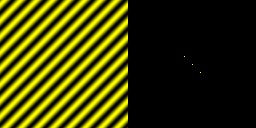
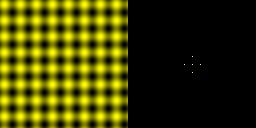

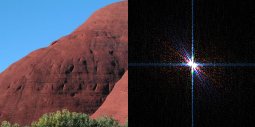
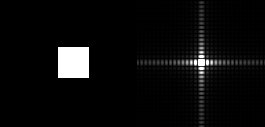
// working with fixed sizes for simplicity in this tutorial
const int W = 128; //the width of the image
const int H = 128; //the height of the image

double fRe[H][W][3], fIm[H][W][3], fAmp[H][W][3]; //the signal's real part, imaginary part, and amplitude
double FRe[H][W][3], FIm[H][W][3], FAmp[H][W][3]; //the FT's real part, imaginary part and amplitude
double fRe2[H][W][3], fIm2[H][W][3], fAmp2[H][W][3]; //will become the signal again after IDFT of the spectrum
double FRe2[H][W][3], FIm2[H][W][3], FAmp2[H][W][3]; //filtered spectrum

double pi = 3.1415926535897932384626433832795;

void draw(int xpos, int yPos, int w, int h, const double *g, bool shift, bool neg128);
void DFT2D(int w, int h, bool inverse, const double *gRe, const double *gIm, double *GRe, double *GIm);
void FFT2D(int w, int h, bool inverse, const double *gRe, const double *gIm, double *GRe, double *GIm);
void calculateAmp(int w, int h, double *ga, const double *gRe, const double *gIm);
|
int main(int /*argc*/, char */*argv*/[])
{
screen(3 * W,4 * H + 8, 0,"2D FFT and Filters");
std::vector
|
    if(keyPressed(SDLK_z) || changed)
    {
      for(int y = 0; y < H; y++)
      for(int x = 0; x < W; x++)
      for(int c = 0; c < 3; c++)
      {
        fRe2[y][x][c] = fRe[y][x][c];
      } changed = 1;
    } //no effect
    if(keyPressed(SDLK_a))
    {
      for(int y = 0; y < H; y++)
      for(int x = 0; x < W; x++)
      for(int c = 0; c < 3; c++)
      {
        fRe2[y][x][c] = 255 - fRe[y][x][c];
      }
    changed = 1;} //negative
    if(keyPressed(SDLK_b))
    {
      for(int y = 0; y < H; y++)
      for(int x = 0; x < W; x++)
      for(int c = 0; c < 3; c++)
      {
        fRe2[y][x][c] = fRe[y][x][c]/2;
      }
      changed = 1;
    } //half amplitude


    //ETCETERA... *snip*

    if(keyPressed(SDLK_SPACE)) endloop = 1;
|
    if(changed)
    {
      //Draw the image and its FT
      calculateAmp(W, H, fAmp2[0][0], fRe2[0][0], fIm2[0][0]);
      draw(0, ytrans, W, H, fRe2[0][0], 0, 0);  draw(W, 0+ytrans, W, H, fIm2[0][0], 0, 0);  draw(2 * W, 0+ytrans, W, H, fAmp2[0][0], 0, 0); //draw real, imag and amplitude
      FFT2D(W, H, 0, fRe2[0][0], fIm2[0][0], FRe[0][0], FIm[0][0]);
      calculateAmp(W, H, FAmp[0][0], FRe[0][0], FIm[0][0]);
      draw(0,H + ytrans, W, H, FRe[0][0], 1, 1);  draw(W, H + ytrans, W, H, FIm[0][0], 1, 1);  draw(2 * W, H + ytrans, W, H, FAmp[0][0], 1, 0); //draw real, imag and amplitude
      print("Press a-z for effects and space to accept", 0, 0, RGB_White, 1, ColorRGB(128, 0, 0));
      redraw();
    }
    changed = 0;
  }
  changed = 1;
  while(!done())
  {
    readKeys();
|
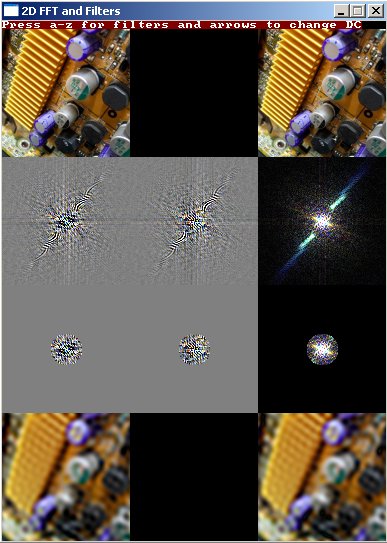
    if(keyPressed(SDLK_g))
    {
      for(int y = 0; y < H; y++)
      for(int x = 0; x < W; x++)
      for(int c = 0; c < 3; c++)
      {
        if(x * x + y * y < 64 || (W - x) * (W - x) + (H - y) * (H - y) < 64 || x * x + (H - y) * (H - y) < 64 || (W - x) * (W - x) + y * y < 64)
        {
          FRe2[y][x][c] = FRe[y][x][c];
          FIm2[y][x][c] = FIm[y][x][c];
        }
        else
        {
          FRe2[y][x][c] = 0;
          FIm2[y][x][c] = 0;
        }
      }
      changed = 1;
    } //LP filter

    if(keyPressed(SDLK_h))
    {
      for(int y = 0; y < H; y++)
      for(int x = 0; x < W; x++)
      for(int c = 0; c < 3; c++)
      {
        if(x * x + y * y > 16 && (W - x) * (W - x) + (H - y) * (H - y) > 16 && x * x + (H - y) * (H - y) > 16 && (W - x) * (W - x) + y * y > 16)
        {
          FRe2[y][x][c] = FRe[y][x][c];
          FIm2[y][x][c] = FIm[y][x][c];
        }
        else
        {
          FRe2[y][x][c] = 0;
          FIm2[y][x][c] = 0;
        }
      }
      changed = 1;
    } //HP filter

    if(keyPressed(SDLK_t))
    {
      for(int y = 0; y < H; y++)
      for(int x = 0; x < W; x++)
      for(int c = 0; c < 3; c++)
      {
        if((x * x + y * y < 256 || (W - x) * (W - x) + (H - y) * (H - y) < 256 || x * x + (H - y) * (H - y) < 256 || (W - x) * (W - x) + y * y < 256) && (x * x + y * y > 128 && (W - x) * (W - x) + (H - y) * (H - y) > 128 && x * x + (H - y) * (H - y) > 128 && (W - x) * (W - x) + y * y > 128))
        {
          FRe2[y][x][c] = FRe[y][x][c];
          FIm2[y][x][c] = FIm[y][x][c];
        }
        else
        {
          FRe2[y][x][c] = 0;
          FIm2[y][x][c] = 0;
        }
      }
      changed = 1;
    } //BP filter

    //ETCETERA... *snip*
|
    if(changed)
    {
      //after pressing a key: calculate the inverse!
      FFT2D(W, H, 1, FRe2[0][0], FIm2[0][0], fRe[0][0], fIm[0][0]);
      calculateAmp(W, H, fAmp[0][0], fRe[0][0], fIm[0][0]);
      draw(0, 3 * H + ytrans, W, H, fRe[0][0], 0, 0);  draw(W, 3 * H + ytrans, W, H, fIm[0][0], 0, 0);  draw(2 * W, 3 * H + ytrans, W, H, fAmp[0][0], 0, 0);
      calculateAmp(W, H, FAmp2[0][0], FRe2[0][0], FIm2[0][0]);
      draw(0, 2 * H + ytrans, W, H, FRe2[0][0], 1, 1);  draw(W, 2 * H + ytrans, W, H, FIm2[0][0], 1, 1);  draw(2 * W, 2 * H + ytrans, W, H, FAmp2[0][0], 1, 0);
      print("Press a-z for filters and arrows to change DC", 0, 0, RGB_White, 1, ColorRGB(128, 0, 0));
      redraw();
    }
    changed=0;
  }
  return 0;
}
|
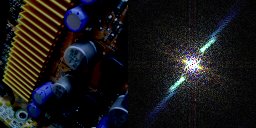
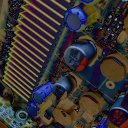

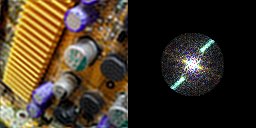
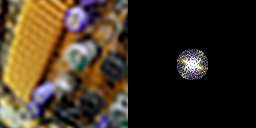
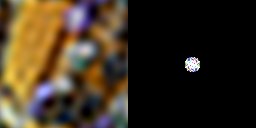
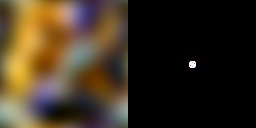
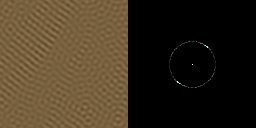
您也可以保留一个正方形区域,但圆形区域应该能产生更好的模糊效果:
附注:对于某些类型的模糊,例如高斯模糊,还有比 FFT 更快的算法,不需要 FFT 也不需要大卷积核。对于高斯模糊,可以通过连续进行三次对任意大小的盒子都能在线性时间内完成的盒式模糊来很好地近似,更多内容请参见本系列的滤波教程。
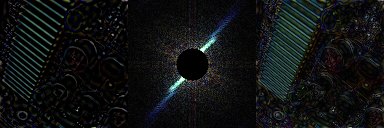
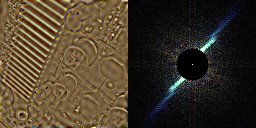
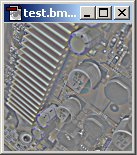
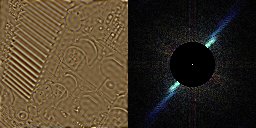

附注:对于锐化,也有比 FFT 更快的算法,例如使用快速模糊然后计算以下图像之和:original + (original - blur) * amount。这就是"反锐化蒙版"(unsharp masking)。